The AI suite for perioperative care
Perimind automates the routine work and augments your judgment where expertise matters, so your practice can do what was never possible before. Built by physicians.
Shown with sample data.
AI Anesthesiologist
Expert perioperative answers, whenever you need one.
Ask about preoperative planning, intraoperative management or postoperative care and get a clear, specific answer grounded in clinical references.
- Preoperative planning
- Medications, comorbidities, airway and fasting questions before the case.
- In the room
- Fast answers on dosing, hemodynamics and complications.
- Recovery
- Postoperative pain, nausea and disposition questions.
- Built by anesthesiologists
- Designed with board-certified anesthesiologists.
Patient on weekly semaglutide for a lumbar fusion tomorrow. How should I plan the airway?
AI Anesthesiologist
- Hold the GLP-1 agonist per your institution’s current guidance, and treat the patient as a possible full stomach if it was continued.
- Consider gastric ultrasound before induction. If residual contents are seen, plan a rapid sequence induction.
- Document the last dose and any GI symptoms in the preoperative note.
Example answer, for illustration. Always follow your institution's protocols.
Op Note Writer
Dictate a few sentences. Get the full note, written the way you write.
It learns from your past operative notes and from every edit you make, so each new note matches your format, your wording and your habits. It checks the note for coding as you go, and one click sends it to billing.
- Learns from your notes
- Upload a few past notes and it copies your structure and phrasing.
- Gets better as you edit
- Your corrections become preferences for every future note.
- 90% there on the first draft
- Routine steps are written in and flagged; case details you leave out are marked to fill in.
- Coding built in
- See the codes the note supports and what to document to bill the rest cleanly.
Your dictation
L4-5 TLIF from the left, Creo 6.5x45 screws, 10 mm Sustain cage. EBL 200, Hemovac. No complications.
Writing in your style
PROCEDURE PERFORMED:
1. L4-5 transforaminal lumbar interbody fusion, left.
2. Posterior segmental instrumentation, L4-L5.
IMPLANTS: Creo 6.5 x 45 mm pedicle screws x4, 10 mm Sustain cage.
ESTIMATED BLOOD LOSS: 200 mL. DRAINS: Hemovac x1.
INDICATIONS: The patient is a [___]-year-old with neurogenic claudication refractory to conservative care.
Missing details are left as [___] for you to fill in, never guessed.
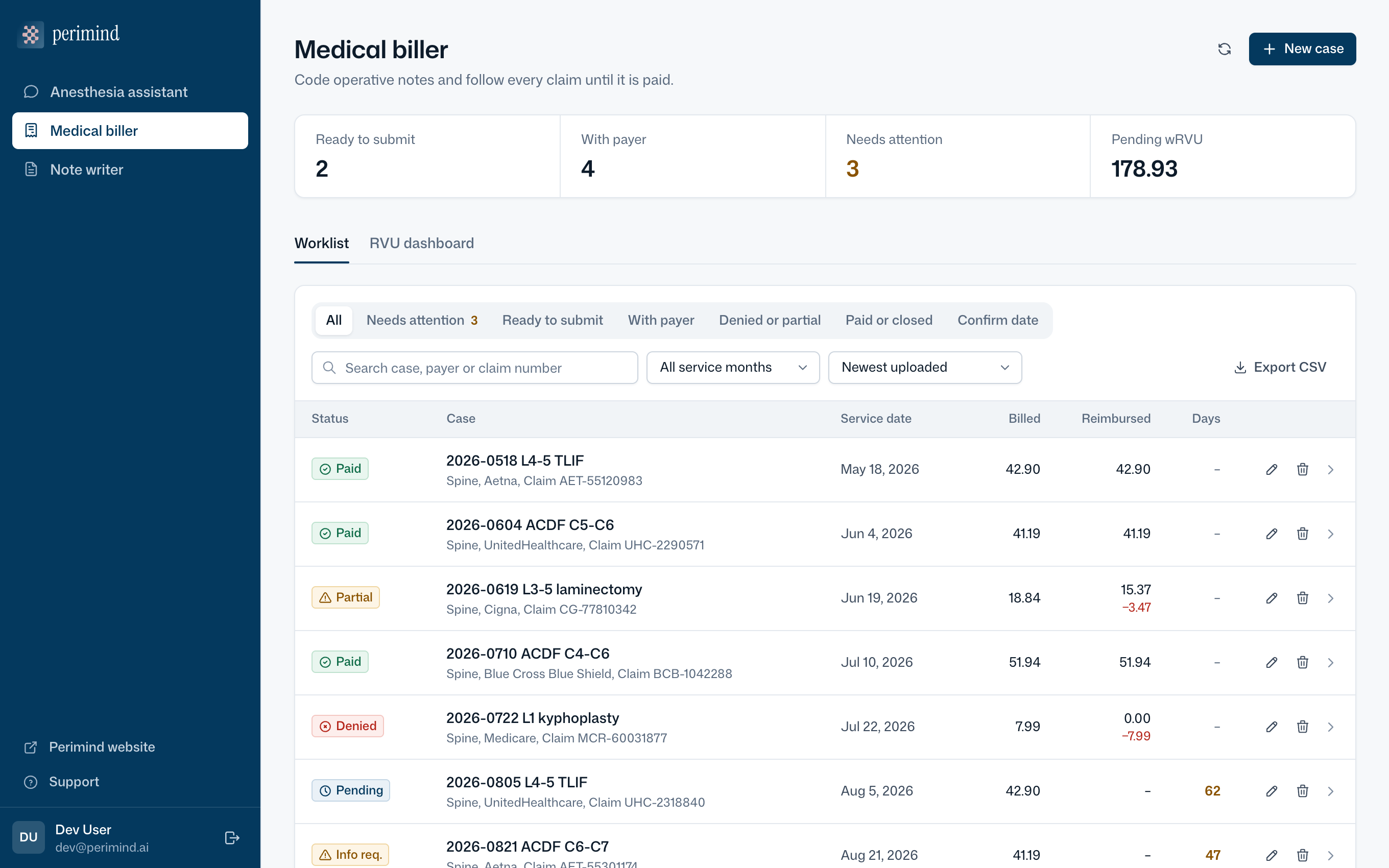
Revenue Optimizer
Don't leave revenue on the table.
Turns operative notes into CPT and ICD-10 codes with work RVUs, flags documentation gaps and likely undercoding, then follows each claim from submission to payment.
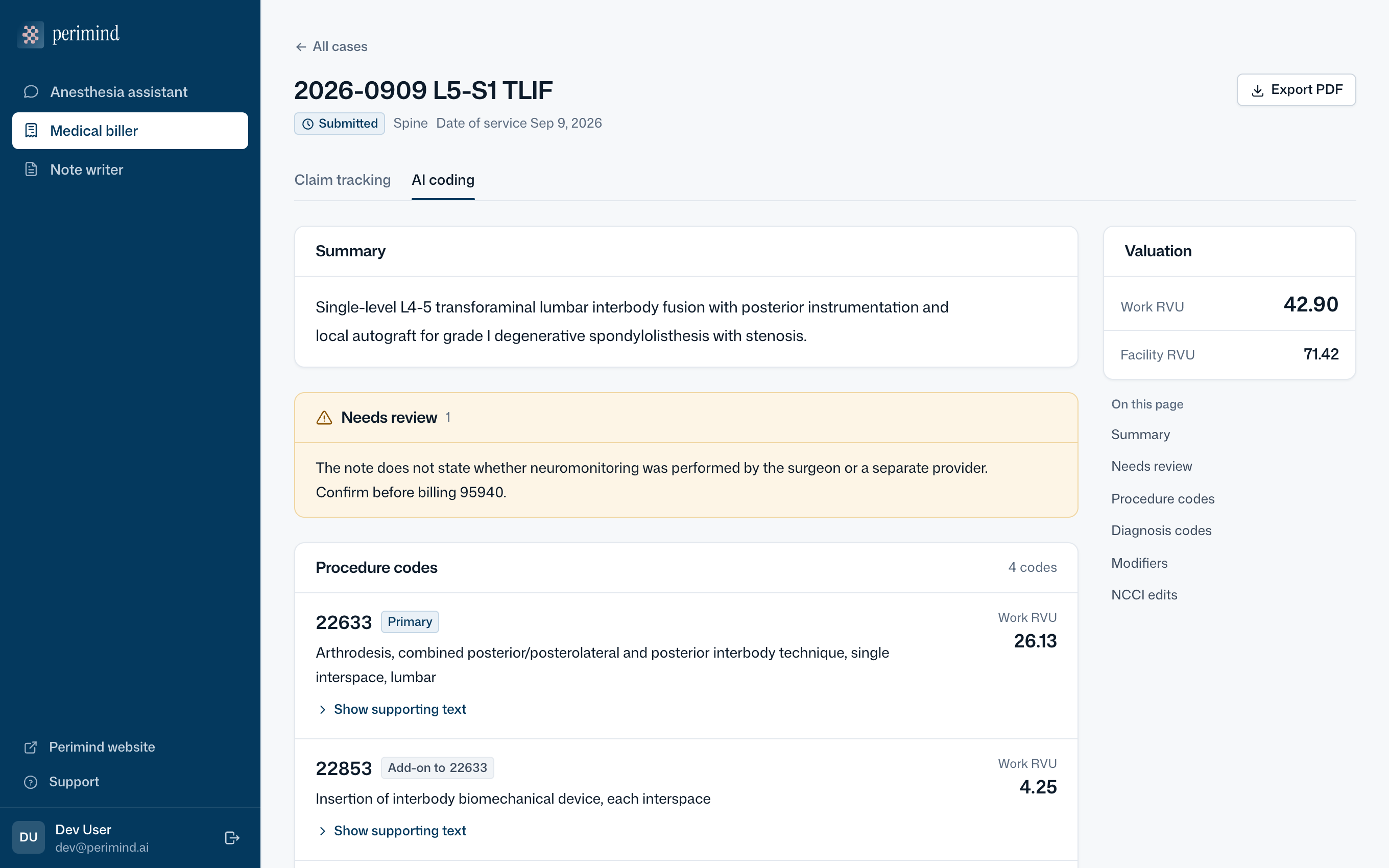
- Coding with reasons
- Every code comes with the note text that supports it.
- Documentation gaps
- Flags missing detail before you submit.
- Claim tracking
- EOBs and denial letters are read by AI and suggested as updates.
- Monthly wRVUs
- Billed against reimbursed, by month of service.
Patient data stays protected
Patient identifiers are removed before any text reaches the AI, and everything runs in our Microsoft Azure environment.
Physician-founded. Princeton-engineered.
Board-certified physicians and engineers from Princeton, building clinical AI side by side.
Meet the team



Working toward general availability
Perimind is in active development with select clinical partners. For pilots, licensing or other inquiries, get in touch.